
Ambra Health vs Medicai for Cloud-Based Medical Imaging Solutions
Your hospital or clinic is deciding between Ambra Health and Medicai for cloud-based medical imaging and needs a direct comparison before signing another vendor contract.
By the final section you will see which platform matches your storage, security, and workflow requirements, where the pricing differs, and the concrete reasons most teams pick one over the other. The verdict uses the same criteria every buyer evaluates: storage scalability, compliance, AI tools, and total cost.
Quick Verdict: Ambra Health vs Medicai for Cloud-Based Medical Imaging Solutions
Medicai processes over 1 million studies annually with 1.7 million studies in its cloud storage, while Ambra Health offers comparable cloud PACS functionality. Both platforms support medical imaging workflows and teleradiology use cases. The key differences emerge when comparing specific metrics around storage capacity, compliance, deployment, and pricing.
Storage capacity stands out as a clear advantage for Medicai. The platform currently holds 2 million imaging studies uploaded and maintains active storage for 1.7 million studies. Ambra Health provides enterprise-scale storage, though specific capacity metrics remain less transparent in public documentation. For the next step, read our overview of Does High Blood Pressure Cause Fatigue.
Compliance certifications represent another differentiator. Medicai maintains HIPAA and GDPR compliance while following OWASP security guidelines. The platform also offers FDA and CEE cleared viewers. Ambra Health holds standard healthcare compliance certifications, though the scope of its regulatory clearances varies by deployment model.
Deployment speed favors Medicai's SaaS model with Microsoft Azure partnership infrastructure. Organizations can access the platform without extensive on-premise hardware setup. Ambra Health offers both cloud and hybrid deployment options, which may extend implementation timelines depending on customization requirements.
Pricing structures differ significantly between the platforms. Medicai provides a Starter tier at $249 per month with clear entry-level access. Ambra Health follows typical enterprise pricing models that require custom quotes based on volume and feature requirements.
API transaction volume and uptime commitments provide additional comparison points. Medicai handles 50 million yearly API transactions with defined service level agreements. Ambra Health maintains enterprise-grade API capabilities, though specific transaction volumes and uptime percentages require direct inquiry during procurement discussions.
At a glance: how Medicai compares to Ambra Health, Medicai for Cloud-Based Medical Imaging Solutions on the features that matter most.
| Feature | Medicai | Ambra Health | Medicai for Cloud-Based Medical Imaging Solutions |
|---|---|---|---|
| Cloud-Based Medical Imaging Solutions | ✓ | ✓ | ✓ |
What Is Medicai?
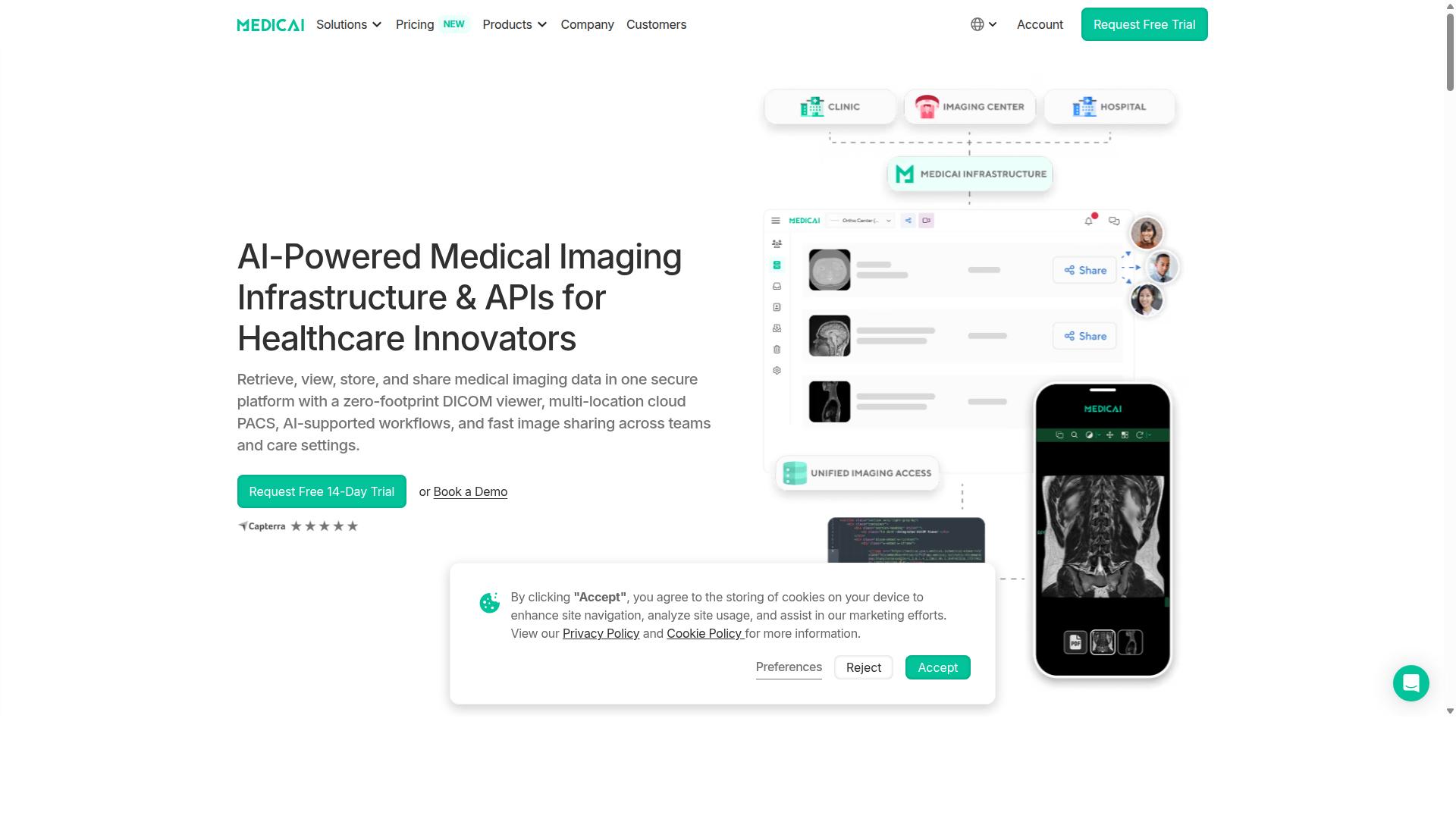
Medicai operates as a cloud-based medical imaging platform providing secure storage, retrieval, and sharing capabilities for healthcare providers worldwide. The platform supports Imaging Infrastructure as a Service through a completely browser-based approach that eliminates local installation requirements.
The solution features a zero-footprint DICOM viewer that loads directly in any modern web browser. This viewer connects to cloud infrastructure running on Microsoft Azure and Amazon AWS, delivering reliable performance across different geographic regions without dedicated on-premise servers.
Healthcare organizations access these capabilities through a SaaS subscription model. No capital expenditure for hardware or maintenance contracts is required, allowing facilities to focus resources on clinical operations rather than IT infrastructure management.
Teams benefit from multi-location cloud PACS capabilities that consolidate imaging data from multiple sites into a single accessible repository. The platform supports AI-supported workflows that connect with existing radiology systems through standard interoperability protocols. Our breakdown of Is Biotin Good for You? Benefits, Risks, and Evidence covers the related details.
Fast image sharing across teams and care settings enables referring physicians to review studies without specialized software installations. This approach addresses common barriers that slow down consultations and second opinion processes in traditional imaging environments.
What Is Ambra Health?
Ambra Health provides cloud-based medical imaging services that enable healthcare organizations to archive, exchange, and access DICOM studies through web-based interfaces. The platform serves hospitals, imaging centers, and specialty practices that need reliable image management without maintaining physical servers.
Cloud PACS solutions like Ambra Health typically focus on image archiving and sharing capabilities. These systems allow medical facilities to store radiology studies in centralized repositories while providing access to authorized users across different locations.
Many healthcare organizations use Ambra Health for image sharing between referring physicians and radiologists. The service supports basic teleradiology workflows and helps facilities reduce the need for physical media transfers.
Research suggests that cloud PACS adoption continues to grow as facilities seek scalable alternatives to traditional on-premise systems. Ambra Health represents one option within this expanding market of medical imaging solutions.
When evaluating cloud PACS vendors, organizations should consider factors such as interoperability capabilities, security standards, and integration requirements. Each provider offers different approaches to meeting these needs.
What Is Medicai for Cloud-Based Medical Imaging Solutions?

Medicai delivers cloud-based medical imaging through its CONNECT & RETRIEVE, STORE & MANAGE, and ACCESS, VISUALIZE, COLLABORATE service tiers.
The CONNECT & RETRIEVE tier handles image intake through its Medical Imaging Uploader and DICOM Gateway. These tools enable facilities to retrieve studies from outside sources and bring them into the platform without manual file transfers.
The STORE & MANAGE tier supports long-term data retention with Cloud PACS, Vendor Neutral Archive, and Backup and Disaster Recovery capabilities. These services help organizations maintain compliant image archives while reducing on-premise hardware requirements.
The ACCESS, VISUALIZE, COLLABORATE tier provides tools for viewing and sharing studies. The zero-footprint DICOM viewer works across devices without local installation, while the patient portal allows secure access to imaging records for referring physicians and patients.
Additional capabilities include structured reporting for radiology, doctor imaging portal, patient imaging portal, Medicai Imaging API, and mobile imaging app. These features support teleradiology workflows and tumor board collaboration without requiring separate systems.
Features Compared
Both platforms offer core PACS functionality but differ in specific implementation approaches for storage, security, and workflow integration.
Medical imaging teams need solutions that scale with growing study volumes while maintaining data protection standards. Cloud PACS selection affects daily operations, cost structure, and integration capabilities across multiple facilities.
The following comparison examines three critical areas where these platforms diverge in their technical approach and service delivery models.
Storage and Scalability
Medicai's Standard plan provides 2 TB of cloud storage with one connected location at $749 monthly, scaling from the Starter plan's 500 GB capacity.
Ambra Health offers a general cloud storage approach that lacks published tier structures or clear expansion limits. Healthcare organizations using vendor neutral archive solutions often need predictable capacity planning for budgeting purposes.
Medicai provides three distinct pricing tiers with defined storage allocations. The Enterprise option includes multiple connected locations and custom storage amounts based on institutional needs.
Expansion occurs through plan upgrades rather than incremental add-ons. Image archiving requirements typically increase over time as radiology departments expand their digital footprint.
Organizations processing 1M+ studies annually require storage infrastructure that grows without service interruption or complex reconfigurations.
Security and Compliance
Medicai maintains HIPAA and GDPR compliance with FDA/CEE cleared viewer technology, processing 50 million API transactions annually under these security frameworks.
Ambra Health describes general security measures without specifying particular compliance certifications or regulatory frameworks. Data protection in medical imaging requires documented adherence to healthcare regulations and encryption standards.
Medicai follows OWASP security guidelines across its platform operations. DICOM viewer access includes cleared technology that meets FDA and CEE requirements for clinical use.
API transaction volumes reaching 50 million annually demonstrate the platform's capacity to handle enterprise-scale operations while maintaining security protocols. Zero-footprint viewer deployment reduces local installation risks for referring physicians accessing studies remotely.
Compliance documentation supports audit requirements in regulated healthcare environments where patient data protection remains paramount.
AI Integration and Workflow Tools
Medicai partners with AI companies including Rayscape.ai, MD.ai, and Boehringer Ingelheim to integrate machine learning capabilities into imaging workflows.
Ambra Health provides general workflow integration without specified partnerships for artificial intelligence capabilities. AI imaging applications require vendor relationships that provide validated algorithms for clinical use cases.
Medicai collaborates with Tquila Automation for workflow automation tools that streamline radiology processes. Radiology workflow efficiency improves when AI tools integrate directly with existing cloud PACS infrastructure.
Partnerships with Microsoft Azure provide additional cloud computing resources for AI processing demands. Diagnostic accuracy benefits from machine learning applications that assist radiologists in image analysis and case prioritization.
These integrations support multidisciplinary tumor board workflows where multiple specialists review imaging studies across different geographic locations simultaneously.
Pricing Compared
Medicai offers transparent monthly pricing starting at $249 for 500 GB storage and $749 for 2 TB storage with unlimited user accounts. This approach gives healthcare organizations clear visibility into their costs before committing to any plan.
Ambra Health uses typical enterprise pricing models without specific figures. Many healthcare providers find that enterprise pricing structures create uncertainty during budget planning, particularly for organizations with predictable imaging volumes.
Starter plan includes 500 GB of cloud storage and unlimited user accounts but does not support connected locations. This option works well for smaller practices or individual radiologists who need basic cloud PACS functionality without complex networking requirements.
Standard plan expands to 2 TB of storage capacity while maintaining unlimited user accounts and adding one connected location. This tier suits mid-sized facilities that require integration with existing PACS systems or teleradiology workflows.
Enterprise plan offers custom pricing with flexible storage allocations and multiple connected locations. Organizations with extensive imaging networks or multi-site operations typically select this option to accommodate their specific requirements.
Yearly billing provides 15 percent savings, reducing the Starter plan to $209 per month and the Standard plan to $639 per month. This payment structure benefits facilities with stable budgets who prefer predictable annual costs over monthly fluctuations.
The DICOM Gateway setup costs $1,000 one time per location for organizations requiring on-premise connectivity. This fee covers the technical infrastructure necessary for secure image routing between local systems and the cloud platform.
| Plan | Medicai | Ambra Health |
|---|---|---|
| Starter | $249/month, 500 GB, unlimited users, no connected locations | Enterprise pricing model |
| Standard | $749/month, 2 TB, unlimited users, one connected location | Enterprise pricing model |
| Enterprise | Custom pricing, custom storage, multiple locations | Enterprise pricing model |
| Yearly Discount | 15 percent savings available | Not publicly specified |
Per-study pricing remains available for enterprise customers who prefer usage-based billing over fixed monthly fees. Organizations with variable imaging volumes often find this option more cost-effective than traditional subscription models.
Free 14-day trial of Starter plan features allows potential users to evaluate the platform without financial commitment. No credit card information is required during the trial period, reducing administrative barriers to testing the service.
Who Should Choose Medicai
Healthcare providers requiring transparent pricing, AI integration, and scalable cloud storage from 500 GB to 2 TB should evaluate Medicai's platform. Hospitals and imaging centers often face complex decisions when selecting cloud PACS solutions for medical imaging needs.
Specialty providers in orthopedics, neurology, oncology, radiology, and cardiology benefit from vendor neutral archive capabilities with global accessibility. These departments handle diverse imaging workflows that demand flexible storage and seamless interoperability across multiple systems.
Medicai serves a broad range of healthcare providers including virtual care providers, telemedicine platforms, and teleradiology services. Clinical trials and medical education organizations also utilize the platform for secure image sharing and collaboration across distributed teams.
Providers comparing Ambra Health versus Medicai should consider deployment models and storage flexibility. Some facilities prefer on-premise options while others need SaaS platform accessibility without infrastructure management requirements.
Patient portal features allow direct access for patients while maintaining HIPAA compliance and data security standards. Personal injury lawyers and tumor boards use the platform for streamlined image routing and collaborative review processes.
Specialty care providers in ophthalmology, ob-gyn, pulmonology, dentistry, and gastroenterology find the zero-footprint viewer particularly useful for remote consultations. Mobile access enables referring physicians to review studies from any location without specialized software installation.
Who Should Choose Ambra Health
Organizations seeking established cloud PACS solutions with existing enterprise relationships may consider Ambra Health's imaging services. Healthcare facilities that already maintain contracts with legacy vendors often evaluate this option when continuity matters more than flexibility.
Many hospitals and imaging centers prioritize vendors with long-standing operational histories. These institutions frequently need cloud PACS solutions that connect with current infrastructure without major disruption to existing radiology workflow.
Some facilities value having familiar account management structures in place. Larger health systems sometimes prefer vendors that have demonstrated consistent performance over multiple years across diverse medical imaging environments.
Regional hospital networks with established procurement processes may find Ambra Health suitable. These organizations often prefer incremental changes to their image archiving approach rather than complete platform transitions.
Facilities that require vendor neutral archive capabilities while maintaining certain vendor relationships sometimes select this route. The decision often depends on internal IT bandwidth and existing data security protocols already in place.
Who Should Choose Medicai for Cloud-Based Medical Imaging Solutions?
Medical facilities requiring comprehensive cloud PACS with Medical Imaging Uploader, DICOM Gateway, and Cloud PACS capabilities should consider Medicai.
Organizations that need a vendor neutral archive benefit from storing images in a format that works across different systems. This approach supports future technology changes without data migration headaches.
Hospitals and clinics seeking reliable backup and disaster recovery find that cloud storage provides automatic protection against local system failures. Data remains accessible even during unexpected outages.
Medical practices that handle complex patient cases require integrated Patient Case Management tools. These features organize images, reports, and clinical information in one location for efficient review.
HIPAA and GDPR compliance matters for facilities that treat patients across different regulatory jurisdictions. A single platform that meets both standards reduces compliance management complexity.
Healthcare networks managing multiple locations need consistent image access across all sites. The Medical Image Exchange capabilities support this requirement without separate systems for each facility.
Organizations prioritizing data security appreciate encryption standards that protect sensitive medical information during storage and transmission. These measures address the requirements of modern healthcare data protection.
Final Verdict
Medicai provides transparent pricing from $249 monthly, processes 1 million studies annually, and maintains partnerships with Microsoft Azure and Amazon AWS. The platform supports 70 clinics and hospitals with 10,000 active doctors using its system. This model gives organizations clear cost visibility while handling significant imaging volumes.
Ambra Health offers cloud PACS services but lacks publicly disclosed pricing structures. Organizations considering this vendor often need direct sales consultation to understand total costs. Some practices report that pricing transparency becomes available only after detailed discussions with sales teams.
Research suggests that pricing clarity helps healthcare administrators plan budgets more effectively. Medicai's stated monthly rate allows practices to calculate expenses upfront without lengthy negotiations. This approach reduces uncertainty during procurement processes.
Medicai maintains partnerships with Microsoft Azure and Amazon AWS for its infrastructure needs. These relationships provide scalable cloud resources while meeting industry security standards. The platform follows HIPAA and GDPR compliance requirements for data protection.
Organizations evaluating cloud medical imaging solutions should examine published pricing models alongside compliance documentation. Medicai publishes its starting price point and lists major cloud infrastructure partners openly. Ambra Health requires direct engagement to access comparable details about their service structure.
Both platforms support standard DICOM formats and basic image sharing capabilities. Medicai differentiates itself through documented partnerships and explicit compliance certifications. Practices seeking predictable costs and verified security frameworks find these elements particularly relevant for their evaluations.
Recommended Resources: