
Outrank Alternatives for SEO Agencies: 8 Automated Content Generation Tools Compared
Agencies lose more margin to content production than to any other deliverable. Rising client demands and flat retainers push many teams to look for alternatives, especially when some tools produce thin drafts that need heavy rewriting. The right comparison matters more than the hype.
This article breaks down what SEO agencies should evaluate in automated content generation tools, then compares eight options including Autoblogging.ai, Article Forge, AutoPost, RankYak, theStacc, BabyLoveGrowth, Sorank, and Trolly.ai. You will finish with concrete criteria for scaling output, integrations, and client workflows, plus a clear pick for best overall.
What SEO Agencies Should Look For in Automated Content Generation Tools
SEO agencies evaluating automated content generation tools should prioritize five core criteria: output quality and originality, scalability to handle multiple client campaigns, integration capabilities with existing SEO stacks, brand voice customization, and transparent pricing models. Each criterion carries different weight depending on your client mix, but neglecting any one of them tends to surface problems later in the editorial workflow.
The sections below break down what "good" looks like for each criterion, with concrete thresholds and examples you can apply during a trial or demo.
Output quality and originality sit at the top of the list because agency work is client-facing. A draft that trips plagiarism detection or reads like machine-generated filler damages the relationship you were hired to protect.
When testing AI writing software, run a sample batch through a plagiarism checker and aim for similarity scores below 5%. Pair that with a readability score above 60 on a standard index, which keeps content accessible without dumbing it down.
Experts also recommend reviewing grammar checking results and factual consistency manually. Tools built on large language models such as GPT-3 or GPT-4 can produce fluent text that still drifts from the source material, so a human review step stays mandatory.
- Plagiarism detection: similarity below 5% on sampled output
- Readability: score above 60 for general audience content
- Grammar and syntax: clean passes with minimal manual edits
- Factual grounding: claims traceable to provided sources or keywords
Scalability determines whether a tool supports ten clients or a hundred. Ask vendors how the system performs when generating 100 or more articles per month, and whether output speed or quality degrades as volume climbs.
Content scalability also depends on queue management, batch processing, and how the tool handles multiple user accounts. An agency running several campaigns in parallel needs predictable turnaround, not a system that slows to a crawl during peak periods.
Test this directly. Request a trial that lets you push a realistic monthly volume through the platform before committing to an annual plan.
Integration capabilities decide how well a tool fits your existing SEO content strategy. Publishing directly to WordPress, triggering workflows through Zapier, and syncing performance data from Google Search Console all reduce manual handoffs.
Look for API access as well. Teams running SERP analysis, backlink profile tracking, or content gap analysis in separate platforms benefit when data flows between systems instead of being copied by hand.
A practical checklist for evaluating integrations:
- Native publishing to common CMS platforms
- Automation support through tools like Zapier or Make
- Search Console or analytics data import
- Export formats compatible with your editorial workflow
Fewer integrations mean more time spent on repetitive tasks, which eats into the margin on every retainer.
Brand voice customization separates generic output from content a client will actually approve. Custom tone settings, style guides, and example documents help a tool match the way each brand speaks.
For agencies managing multiple accounts, this matters even more. A single default tone across every client is a fast route to churn, since brand voice consistency is one of the things clients notice first.
Ask whether the platform supports per-client profiles, glossary terms, and preferred phrasing. Some systems let you upload reference content so the model learns patterns from existing pages, including pillar pages and topic clusters.
Semantic SEO adds another layer. Tools that handle natural language processing well can weave in related entities and keyword variations without producing awkward, over-optimized sentences.
Pricing transparency rounds out the evaluation. Credit-based models vary widely, so confirm whether unused credits roll over month to month or expire at the end of each billing cycle.
Team seats matter too. An agency with writers, editors, and account managers all needing access should not pay per head for basic collaboration. Check how many users are included and what extra seats cost.
Watch for these pricing details before signing:
- Credit rollover policy and expiration rules
- Number of included team seats
- Overage charges when volume exceeds the plan
- Contract length and cancellation terms
The goal is a predictable monthly cost you can map to client retainers. A tool that looks cheap per article often becomes expensive once seats, overages, and lost credits are factored in.
Weigh all five criteria together rather than optimizing for one. The strongest automated content generation platforms for SEO agencies balance originality, volume, connectivity, voice control, and clear pricing, because weakness in any single area shows up in client results and retention.
1. Autoblogging.ai - Best Overall
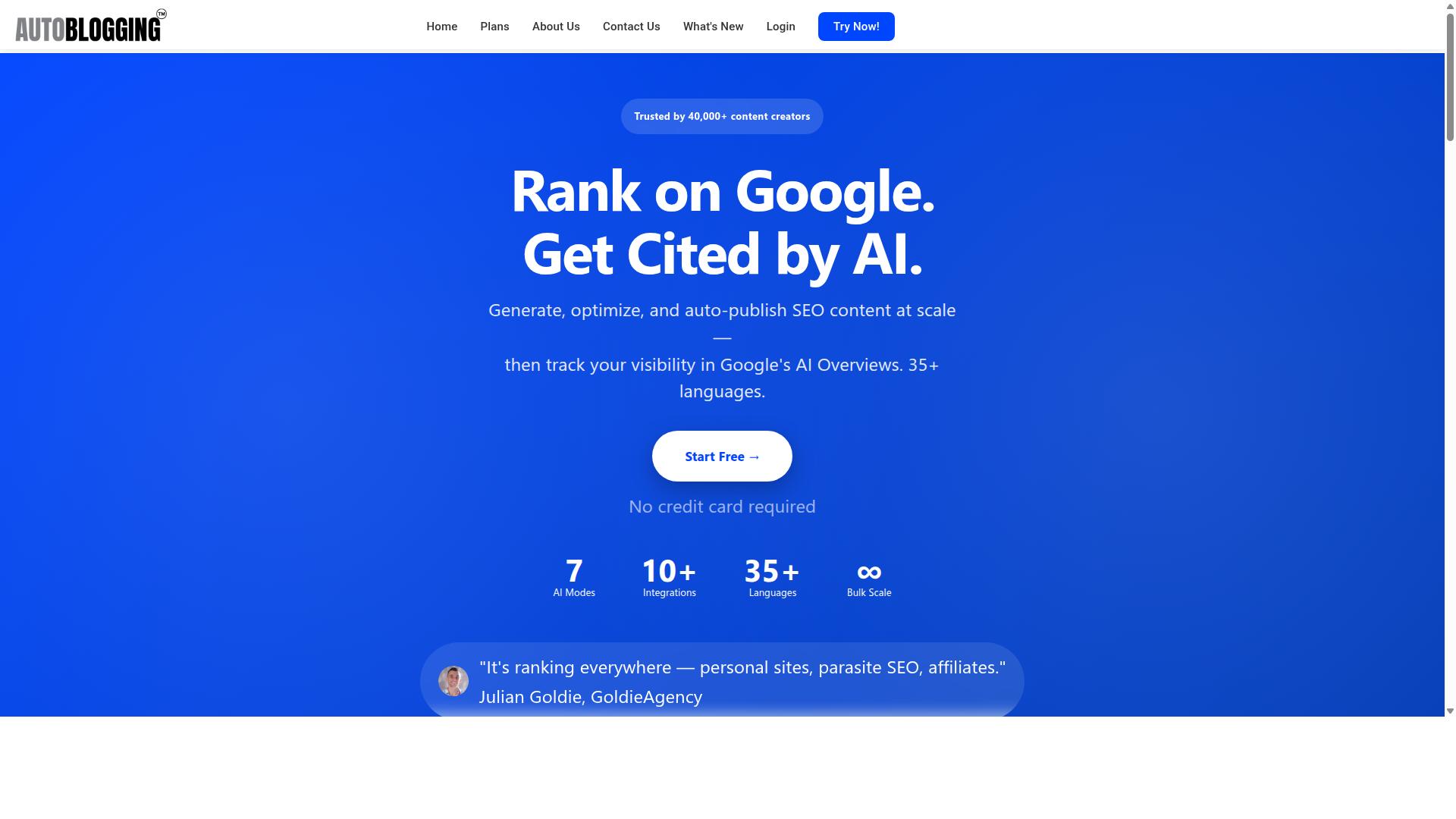
Autoblogging.ai stands out as the best overall automated content generation tool for SEO agencies due to its advanced AI modes, scalability, and agency-focused features. For teams managing multiple clients, the platform combines article production, semantic SEO analysis, and publishing in one place.
The numbers behind it are notable. Autoblogging.ai is trusted by 40,000+ content creators and holds a 4.9 average rating, with more than 1M+ articles generated to date. It supports 10+ AI modes, 35+ languages, and 35+ integrations, and it is available globally.
That mix suits three main audiences: bloggers producing content at volume, agencies handling several clients at once, and SEO professionals who need keyword optimization and SERP analysis built into the writing process. Instead of stitching together separate tools for drafting, auditing, and publishing, an SEO content strategy can run through a single platform.
Other tools in this comparison, such as Jasper AI, Copy.ai, Writesonic, Rytr, Article Forge, ContentBot, Simplified, and Hypotenuse AI, each have their own strengths. What separates Autoblogging.ai here is the depth of its verified feature set and the way those features map to agency workflows.
Key Features, Pricing, and Agency Use Cases
Autoblogging.ai offers a robust feature set including Quick Mode for free single articles, Godlike Mode for SERP competitor analysis and LSI keyword extraction, and Bulk Generation for up to 500 articles via CSV upload. Godlike Mode also covers knowledge graph extraction, which supports semantic SEO rather than surface-level keyword matching.
Beyond generation, the platform includes a set of optimization tools. These include Site Optimizer, Semantic SEO Analysis with a 21-point audit, Snippet Optimizer, Topical Maps, Intense Optimizer, Fan Out Queries, AI Infographics, Outreach Prospects, and an AI Proofreader. A human proofreader is included in all plans, and featured snippet optimization helps target prominent search positions.
Publishing is handled through one-click WordPress integration for unlimited sites, plus Web 2.0 platforms like Medium, Dev.to, Hashnode, Telegraph, and Tumblr. Multi-platform support covers Shopify, Wix, Webflow, Blogger, and Ghost, with API, Zapier, and n8n available for connecting existing systems. A Content Repurposer and Done For You packages round out the offering.
Pricing scales with volume, and credits roll over between periods:
| Plan | Price | Credits |
|---|---|---|
| Starter | $19 | 40 credits |
| Regular | $49 | 120 credits |
| Standard | $99 | 300 credits |
| Gold | $179 | 600 credits |
| Premium | $249 | 1,000 credits |
| Enterprise | $999 | 5,000 credits |
Annual discounts are available for teams planning longer campaigns. For agencies, the practical use cases are straightforward:
- Scaling content across multiple client accounts without rebuilding a process each time
- Maintaining brand voice consistency through repeatable modes and workflows
- Fitting into existing editorial workflows via 35+ integrations
- Adding semantic SEO analysis and snippet optimization to every deliverable
Support runs 24/7, and new features ship weekly, which matters for agencies whose content automation tools need to keep pace with changing search behavior. Combined with credit rollover, that structure supports steady production rather than one-off bursts.
2. Article Forge

Article Forge is a well-known automated content generation tool that uses deep learning to produce unique articles on any topic. It has been part of the automated content generation space for several years, which gives it a level of name recognition among SEO agencies evaluating their options.
The core workflow is straightforward. A user enters a keyword or topic, sets a few parameters, and the tool produces a full article. No manual outlining or drafting is required at the front end, which is the main appeal for teams handling many client accounts at once.
For agencies weighing automated content generation tools, Article Forge typically appears in shortlists alongside Jasper AI, Copy.ai, Writesonic, Rytr, ContentBot, Simplified, and Hypotenuse AI. Each tool approaches the same core problem, turning a keyword into publishable copy, but they differ in workflow, output control, and how well they fit an existing editorial process.
Based on publicly available information, Article Forge commonly offers the following capabilities:
- Keyword-to-article generation using a single seed term or phrase
- Adjustable article length so output can match different content formats
- Uniqueness controls aimed at reducing duplication across generated pieces
- Bulk generation for producing multiple articles in one session
- API access for teams that want to connect generation to their own systems
- WordPress integration to push finished drafts toward a site
Those features matter to SEO agencies because content scalability is often the bottleneck. When a client needs dozens of supporting articles for topic clusters or pillar pages, manual writing does not always fit the budget or timeline. A tool that generates drafts in bulk can feed an editorial workflow rather than replace it.
That said, agencies should treat any single-pass output as a starting point. Keyword optimization, SERP analysis, and brand voice consistency still require human review. Plagiarism detection and grammar checking remain sensible steps before anything goes live, regardless of which AI writing software produced the draft.
Article Forge may be suitable for agencies needing high-volume, low-cost content, particularly for informational pages or early-stage drafts that a writer or editor refines afterward. Teams with stricter quality bars or complex semantic SEO requirements will likely want to test output against their own standards before committing at scale.
The practical takeaway is simple. Evaluate Article Forge the same way you would any content automation tool: run a sample batch, check readability and factual accuracy, and confirm the API and WordPress options fit your existing stack. If the drafts reduce editing time without adding cleanup work, it can earn a place in the workflow.
3. AutoPost
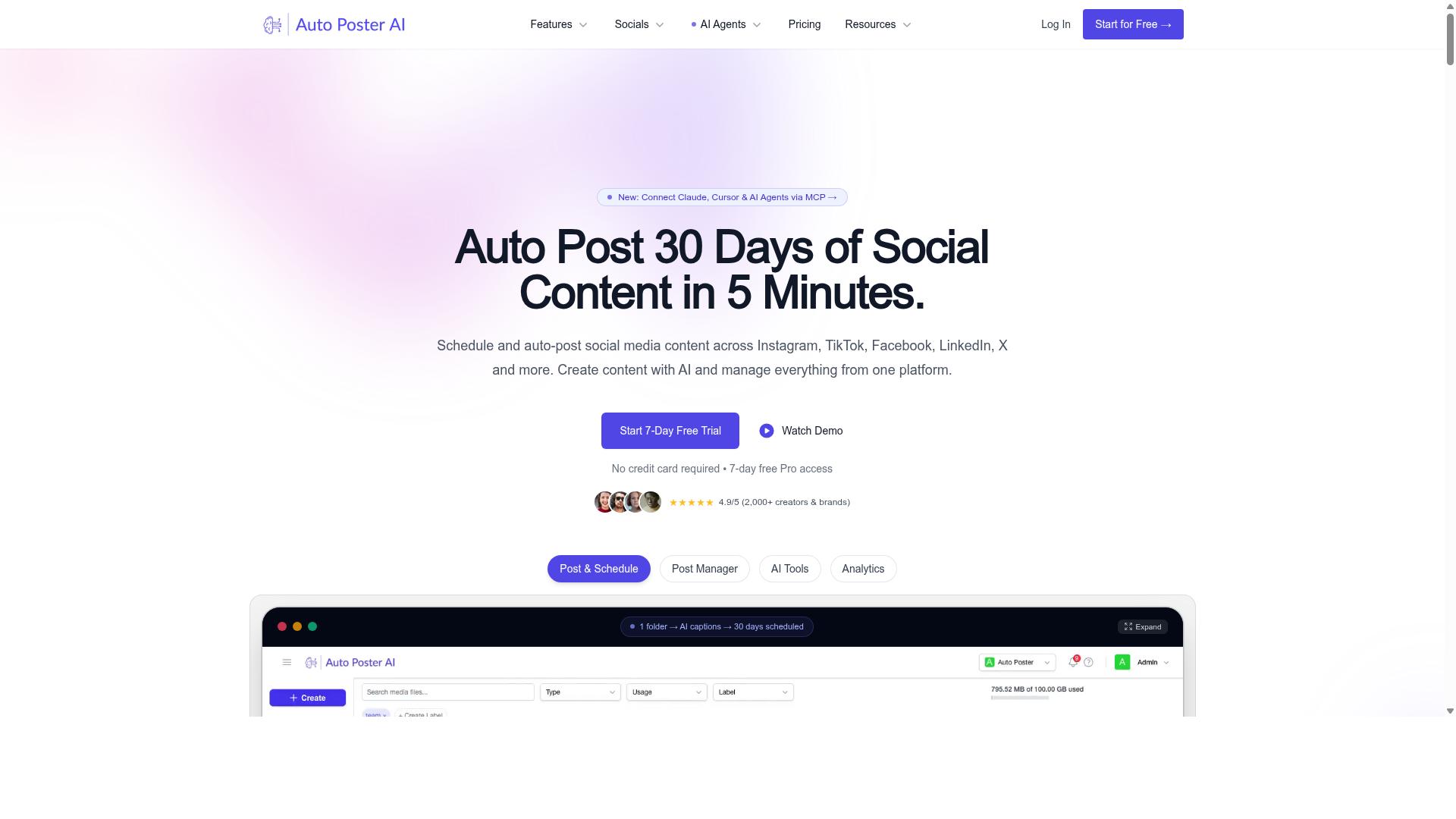
AutoPost is an automated content generation tool designed to streamline blog posting by automatically creating and publishing articles. Its core pitch is pipeline coverage: rather than stopping at draft generation, it aims to carry content from idea through to a live post on your site.
For SEO agencies managing multiple client blogs, that end-to-end framing is the main draw. Fewer manual handoffs between writing, formatting, and publishing means less time spent on repetitive tasks.
Based on publicly available information, AutoPost and similar tools in this category commonly support:
- Connection to WordPress through an application password, allowing plugins to post directly to a site
- Use of your own OpenAI API key for article generation
- Target keyword input so generated content aligns with a page's focus term
- Post settings and AI prompts to shape tone, structure, and formatting
- Scheduling options that help maintain a steady publishing cadence
Some tools in this space also offer free trials, which lets an agency evaluate output quality before committing. Pricing details vary widely across the category, so it is worth checking each provider directly.
AutoPost tends to suit marketers, agencies, and bloggers who are scaling content volume. That said, some agencies might find its automation useful for maintaining a consistent posting schedule, while others may prefer tighter editorial control over every draft.
One caution worth noting: a user in public discussions warned against using this type of tool on important websites without review. For agency work, that points to a sensible middle ground. Let automation handle first drafts and scheduling, then route everything through an editorial workflow that checks accuracy, brand voice consistency, and readability before anything goes live.
In short, AutoPost fits teams that want publishing handled for them. Agencies with strict quality gates may treat it as a drafting engine rather than a set-and-forget solution.
4. RankYak
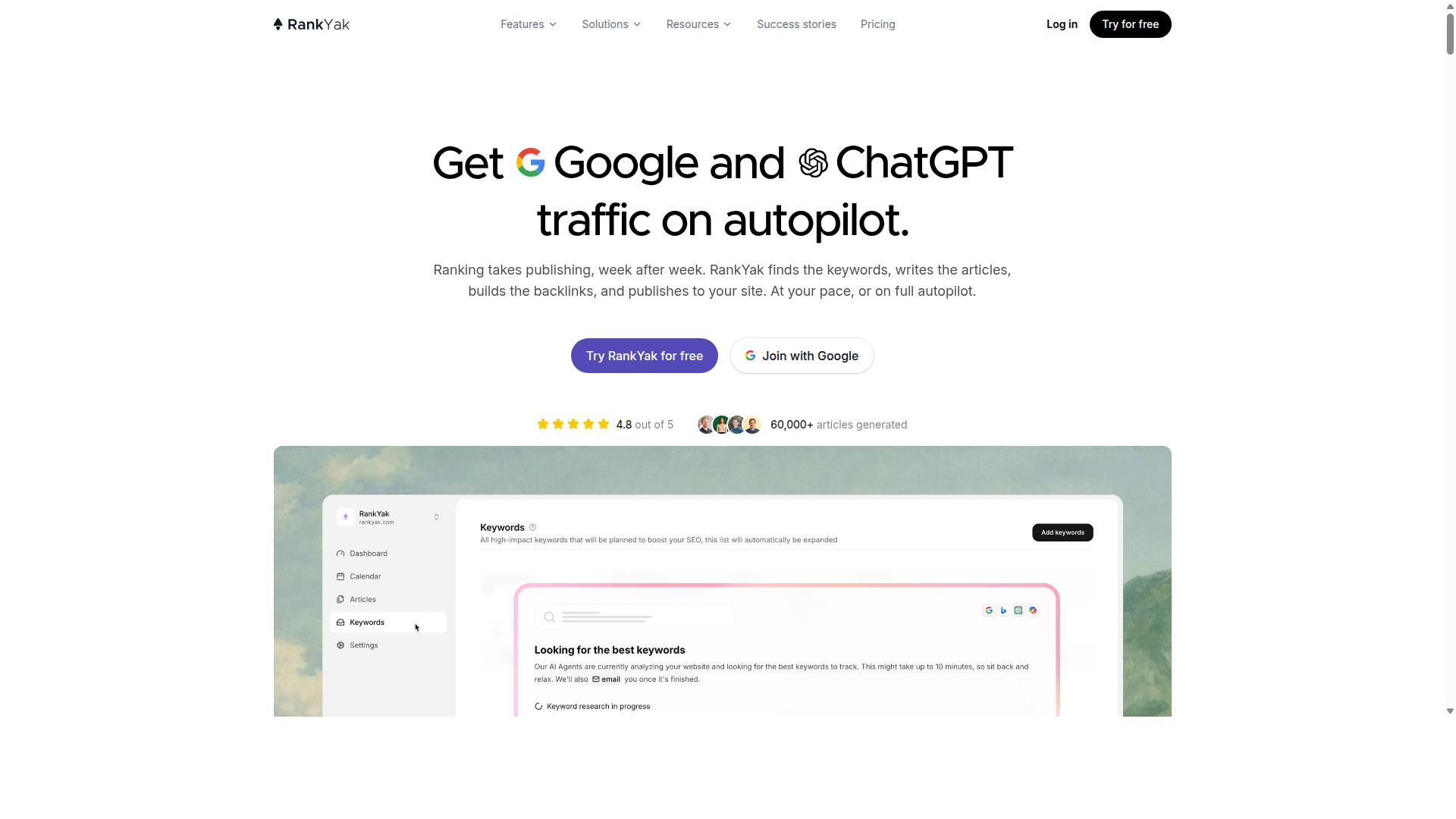
RankYak is an AI-powered content generation tool that focuses on creating SEO-optimized articles for improved search rankings. It positions itself as an SEO automation platform rather than a standalone writing assistant, which shapes how agencies might use it inside a broader SEO content strategy.
The platform bundles several capabilities into one workspace. According to publicly available information, these include keyword discovery, a content plan, article generation, and a feature called Site Guard that finds and fixes pages losing clicks. A backlink exchange, a Copilot assistant, an MCP server, and various integrations round out the offering.
That combination suggests RankYak aims to support the full path from keyword optimization through publishing and monitoring. For agencies managing multiple clients, having discovery and content production in the same tool can reduce the number of separate subscriptions in the stack.
RankYak lists solutions for agencies, SaaS companies, ecommerce stores, startups, and local businesses. Its site messaging centers on getting Google and ChatGPT traffic on autopilot, and it states that users can generate a first article within 15 minutes. A free trial is offered, though pricing details are not stated on the pages reviewed.
Agencies seeking to improve organic traffic may consider RankYak, particularly if they want keyword research and content generation under one roof. Teams that already have a strong research workflow might weigh whether the bundled features add value or overlap with existing content automation tools.
As with any platform in this category, the practical fit depends on client volume, editorial standards, and how much human review the workflow requires. Evaluating RankYak against a defined editorial workflow is a sensible first step before committing.
5. theStacc
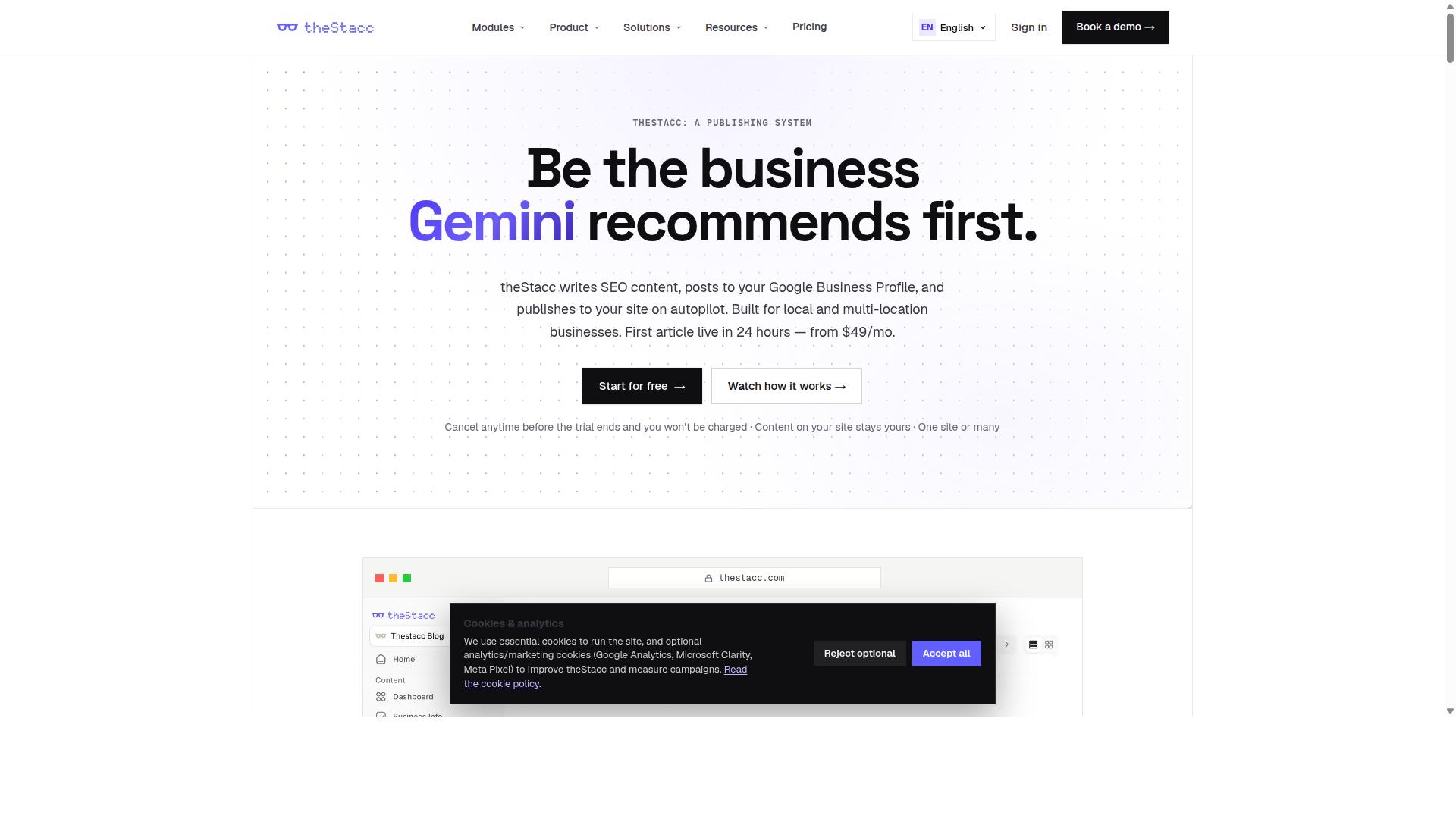
theStacc is a lesser-known automated content generation tool that aims to help agencies scale their content production. It sits in a different category from pure AI writing software, presenting itself as a broader SEO platform with content creation built into a larger workflow.
For agencies comparing content automation tools, that positioning matters. theStacc bundles blog content, local SEO, and social media into one system rather than selling a standalone generator.
The platform is organized into three modules: Blog SEO, Local SEO, and Social Media. Each module targets a distinct agency service line, which some teams may find useful when they want one vendor instead of several point solutions.
Blog SEO includes an AI Blog Writer, Live SEO Scoring, Brand Voice, Auto-Publish, a Content Calendar, Internal Linking, AI Keyword Strategy, and Content Indexing. Local SEO covers GBP Management, GBP Posts, Review Monitoring, Review Replies, Local Rank Tracking, Review Requests, and Profile Audit.
Social Media rounds things out with Social Scheduling, AI Image Generation, Content Repurposing, and Multi-Platform Publishing. That is a wide surface area for a single subscription.
Integration support covers WordPress, Webflow, Ghost, Google Business Profile, Search Console, and Google Analytics. For agencies running client sites on common CMS platforms, that reduces manual export and upload work.
Pricing starts at from US$49/month for the software, with Managed Services starting "From $749 / mo". The lower tier puts it in reach of smaller teams, while the managed option targets agencies that want execution handled for them.
theStacc states it suits agencies, multi-location businesses, franchises, and small businesses. Some agencies might explore theStacc as a budget-friendly option, particularly those already selling local SEO or social services alongside blog content.
Where theStacc stands apart from single-purpose AI writers is scope. It is less a content generator and more an SEO content strategy platform with generation attached.
Teams that mainly need high-volume article output may find the extra modules unnecessary. Teams that want keyword planning, publishing, and local listings under one roof may see better fit.
As with any tool in this roundup, evaluate it against your editorial workflow, not just the feature list. Check how well the brand voice controls hold up across a full client roster before committing at scale.
6. BabyLoveGrowth
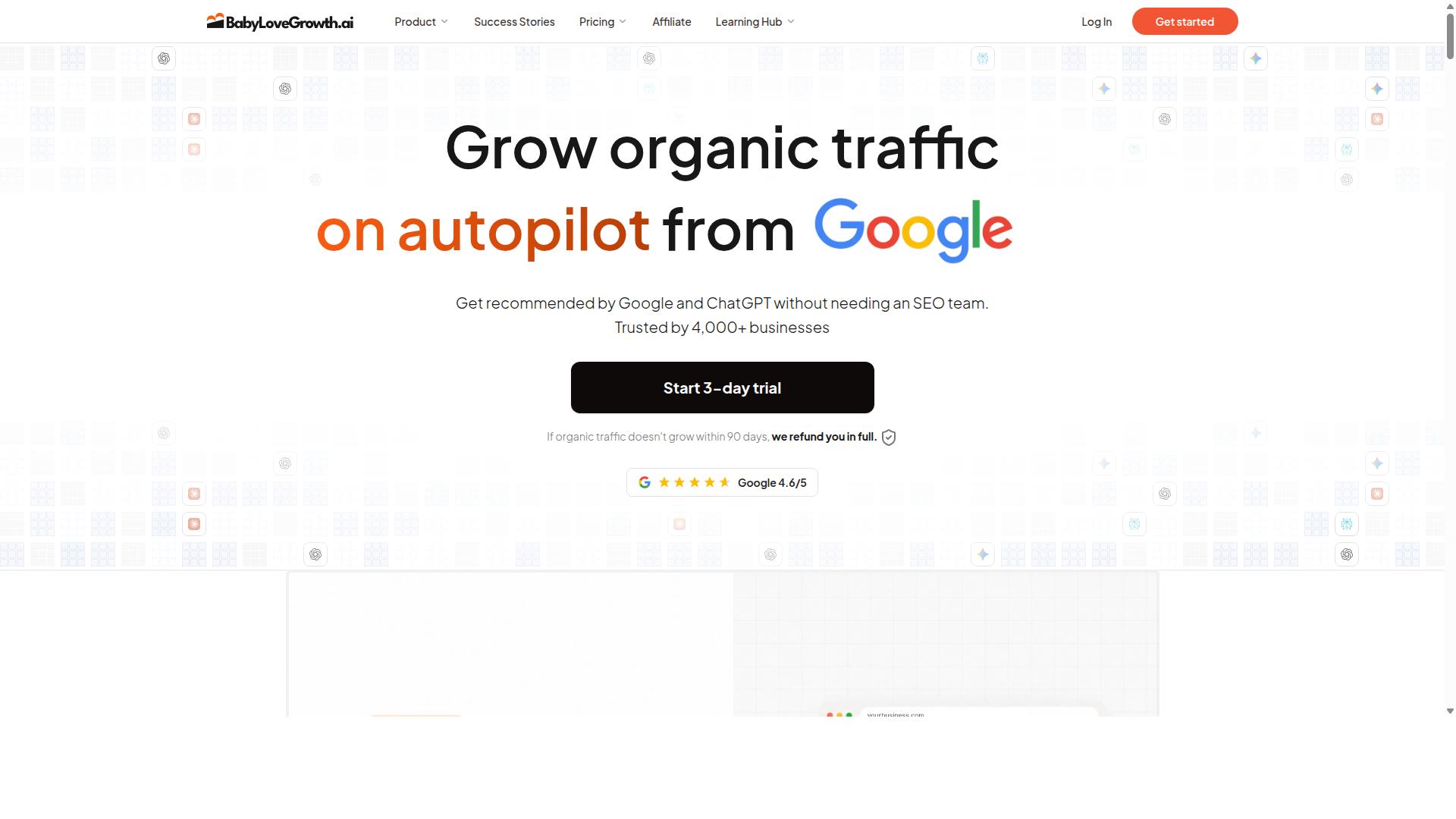
BabyLoveGrowth is an automated content generation tool that focuses on creating engaging content for blogs and websites. It sits in the same broad category as other AI writing software, generating articles from keywords or topic prompts and offering some level of customization before publishing.
Based on publicly available information, the platform is an autoblogger that produces 30 articles a month and publishes them directly to your CMS. It also bundles link building into the package, which places it closer to a done-for-you content service than a standalone writing assistant.
What separates BabyLoveGrowth from simpler tools is the bundled extras. Its feature set includes AI citation tracking plus Reddit and Quora agents, and it carries a 90-day refund policy. For agencies that want distribution and off-page activity handled alongside article production, those additions may matter more than the raw word generation itself.
Pricing is where the comparison gets interesting. BabyLoveGrowth is commonly compared to Outrank.so, since both target the same buyer, both produce 30 articles a month, and both list at $99 on monthly billing. Billed yearly, BabyLoveGrowth drops to $49 a month, which changes the value math considerably for agencies committing to an annual content pipeline.
SEO agencies looking for a user-friendly interface might consider BabyLoveGrowth, particularly if the citation tracking and community agents fit an existing SEO content strategy. The tool appears best suited to buyers for whom those bundled extras are load-bearing rather than window dressing.
As with any automated content generation platform, evaluate the output against your own standards before scaling. Check readability, factual accuracy, and how well drafts hold your brand voice consistency across multiple client accounts.
- Output volume: 30 articles per month, published to your CMS
- Bundled features: link building, AI citation tracking, Reddit and Quora agents
- Pricing: $99 monthly, or $49 a month billed yearly
- Refund policy: 90 days
- Closest comparison: Outrank.so, same buyer and same monthly article count
For agencies weighing content automation tools, BabyLoveGrowth is worth shortlisting when the surrounding services carry as much weight as the articles themselves. If you only need drafts and prefer to manage link building and community outreach in house, a leaner tool may fit better.
7. Sorank
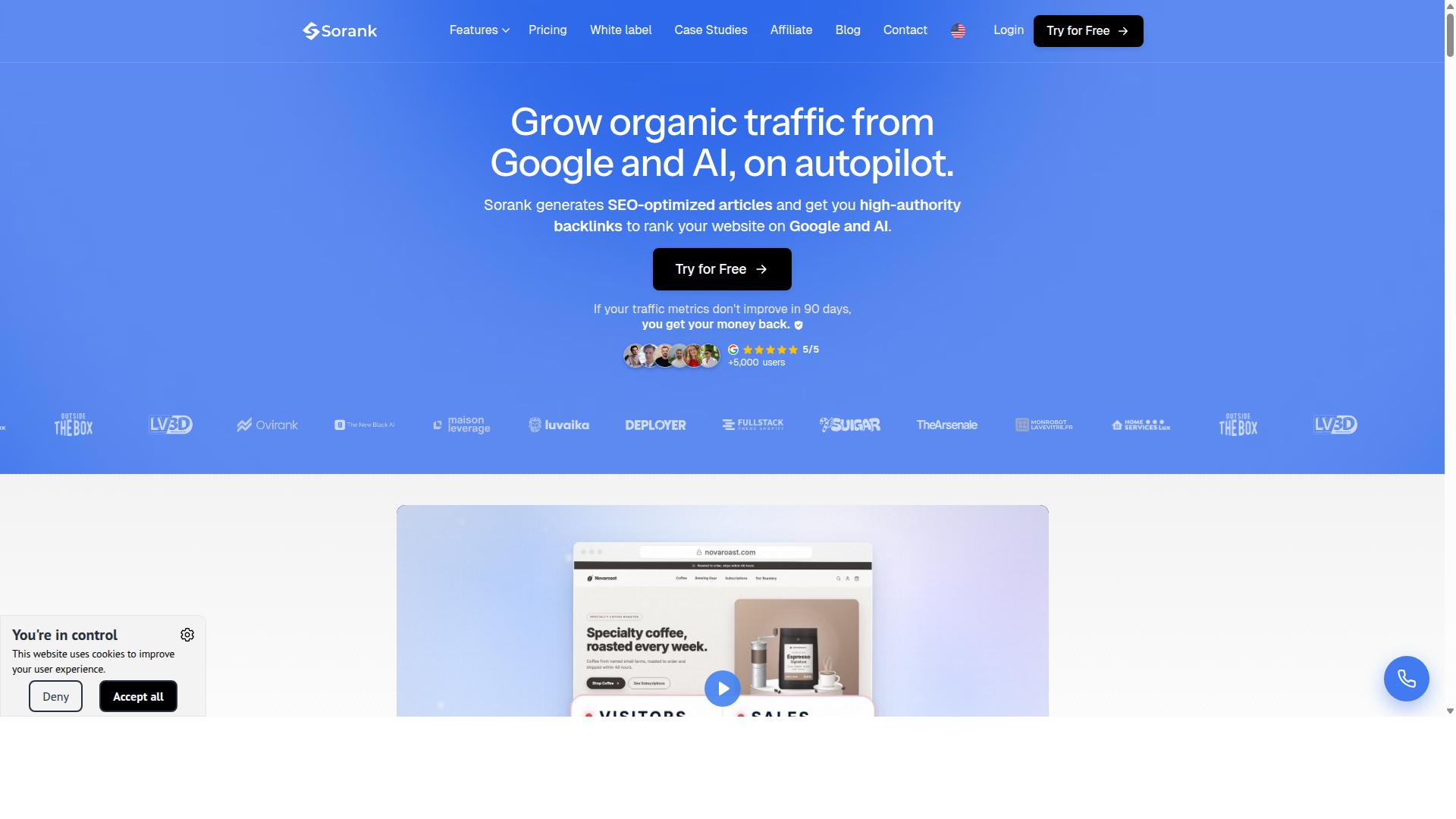
Sorank is an AI-driven content generation platform designed to assist agencies in producing SEO-friendly articles at scale. It sits in the same broad category as other automated content generation tools, aimed at teams that need to publish regularly without expanding headcount.
Public information about Sorank is limited, so agencies evaluating it should treat it as one option among several in this roundup. The sections below cover the general capabilities this type of platform tends to offer and how those capabilities fit into an SEO content strategy.
Platforms like Sorank typically bundle three core functions: keyword research, draft generation, and performance tracking. Keyword tools surface terms with realistic ranking potential, generation tools turn those terms into article drafts, and analytics close the loop by showing what actually gained traction.
Some agencies might find Sorank's analytics useful for refining content strategies over time. That feedback loop matters because keyword optimization is not a one-time task. Search intent shifts, competitors publish new pages, and yesterday's winning topic can stall within months.
Sorank may also support workflow features common to this category, such as:
- Brief creation from a target keyword or topic cluster
- Draft generation with adjustable tone or length settings
- Basic editing and readability checks before publishing
- Performance dashboards tied to published content
Because verified details about Sorank's output quality, pricing, and integrations are scarce, agencies should request a trial or demo before committing. Test it against your own editorial workflow rather than relying on marketing pages alone.
A practical evaluation approach works well here. Run one real brief through Sorank, then compare the draft against your existing process on accuracy, brand voice consistency, and editing time.
If the draft needs heavy rewriting, the time savings shrink. If it needs light edits, the tool earns a place in your stack. This kind of hands-on comparison tells you more than any feature list.
Sorank fits best as a content automation tool for teams already publishing at volume. Agencies producing a handful of articles monthly may find lighter tools sufficient, while those managing multiple client sites often need the scalability this category promises.
Weigh Sorank against the other seven tools in this comparison using the same criteria: keyword depth, draft quality, editing overhead, and how well it supports your content scalability goals. A short trial on live client work remains the most reliable way to judge fit.
8. Trolly.ai
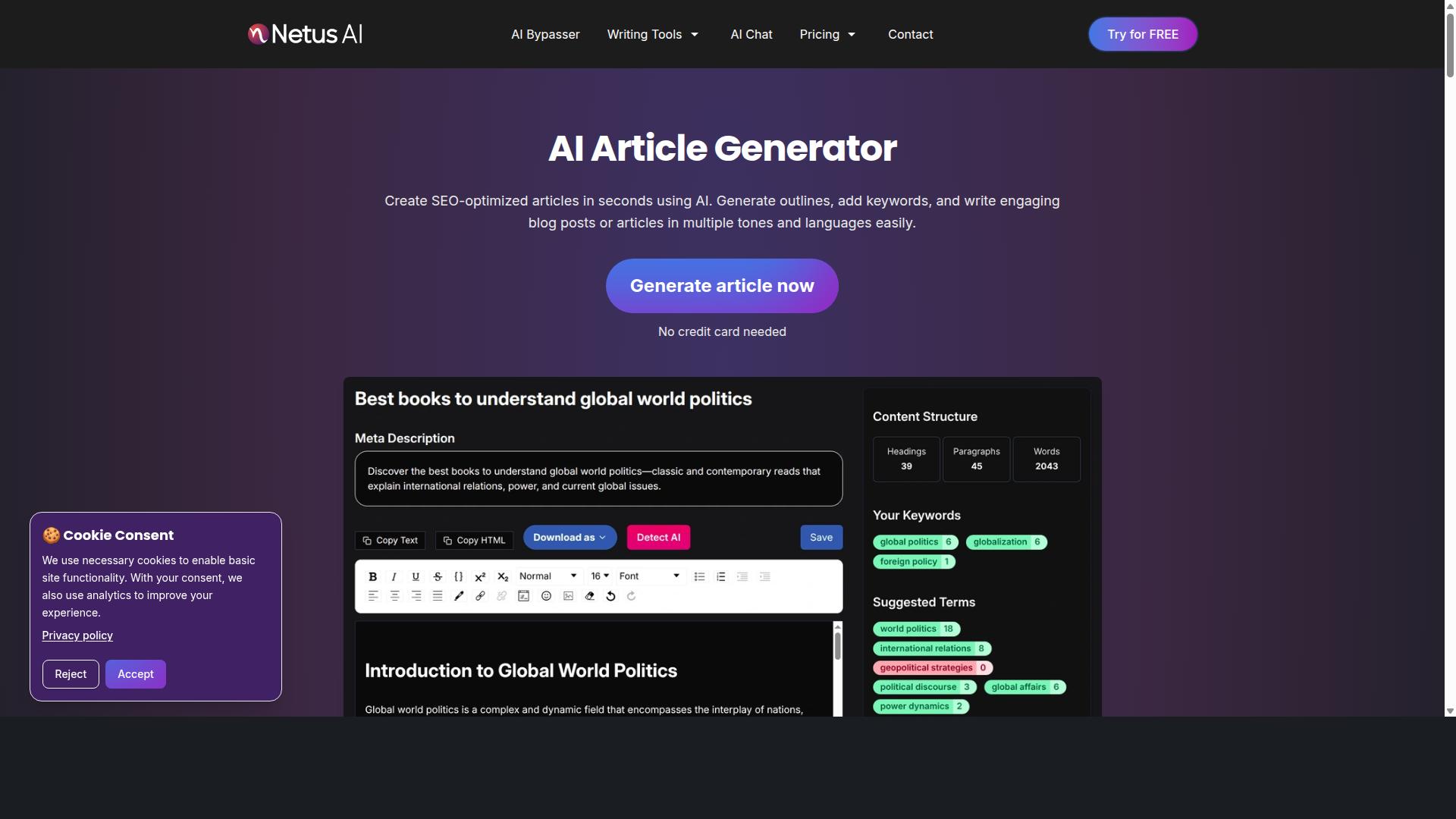
Trolly.ai is an automated content generation tool that leverages AI to create articles and blog posts for various niches. It appears in discussions of automated content generation platforms that SEO agencies evaluate when comparing options for scaling output.
Publicly available information about Trolly.ai is limited. Because of that, agencies should treat any evaluation as provisional and verify current capabilities directly with the vendor before committing budget or workflow changes.
Based on how tools in this category typically operate, a platform like Trolly.ai may offer template-based generation, allowing users to select a structure and populate it with topic-specific content. Bulk creation features are also common among competitors in this space.
Some tools of this type connect with content management systems to streamline publishing. Whether Trolly.ai supports such integrations is not confirmed in available sources, so agencies should confirm this during a trial.
Agencies seeking a simple tool for generating draft content might explore Trolly.ai as part of a broader comparison. The right choice depends on factors like output quality, editing needs, and how well the tool fits an existing editorial workflow.
When assessing any option in this category, SEO agencies should consider:
- How much manual editing generated drafts require before publication
- Whether the tool supports bulk output for multiple clients or campaigns
- Integration options with CMS platforms and existing content automation tools
- Approaches to brand voice consistency across different accounts
- Availability of plagiarism detection and grammar checking features
Evaluating these factors side by side helps agencies build a SEO content strategy that supports content scalability without sacrificing quality. A tool that fits one agency's process may not suit another's.
For teams focused on keyword optimization and search engine ranking, the practical test is whether a tool reduces production time while keeping drafts usable. Trials and sample outputs remain the most reliable way to judge fit.
How to Choose the Right Tool for Your Agency
Choosing the right automated content generation tool for your agency requires aligning your specific needs with the tool's capabilities, scalability, and integration options. A solo blogger publishing on a personal site has very different requirements than a marketing agency managing a dozen client websites at once.
The audience for these tools spans bloggers, website owners, SEO professionals, marketing agencies, content creators, and affiliate marketers. Each group brings its own constraints around budget, output volume, and the types of sites they run.
Before comparing features, map out what you actually need the tool to support. The right platform should handle a range of site types, including personal sites, parasite SEO, affiliate sites, client websites, portfolio sites, and local sites. A tool that only fits one of those use cases will force you into workarounds as your agency grows.
Client volume is the first practical filter. If you manage a handful of accounts, a simple per-article workflow may be enough. If you run dozens of campaigns, you need bulk generation and credit management that will not leave you wasting spend on unused capacity.
Content types matter just as much. Some agencies need long-form blog posts for pillar pages and topic clusters, while others need short product descriptions or local landing pages. Check that the tool's output formats match your SEO content strategy rather than the other way around.
Budget deserves an honest look, including how credits are consumed and whether unused ones carry over. A cheaper subscription that wastes credits every month often costs more than a slightly higher plan with better rollover terms.
Finally, audit your existing tech stack. Tools that plug into your CMS, project management software, and analytics platforms reduce manual handoffs. Those that do not will add hours of copy-and-paste work across every client account.
Scaling Output, Integrations, and Client Workflows
To scale output effectively, agencies should evaluate a tool's bulk generation limits, credit rollover policies, and integration with project management and CMS platforms. These three factors separate tools that work for one site from tools that work for twenty.
Bulk generation is the clearest signal of scalability. Some platforms cap a single run at a modest number of articles, while others support runs of up to 500 articles. For an agency running content campaigns across multiple client sites, that difference determines whether you batch work weekly or babysit the tool daily.
Credit rollover is the quieter factor. Monthly subscriptions that expire unused credits punish agencies with uneven publishing schedules. Rollover policies protect you during slow months and let you stockpile capacity for a heavy launch period.
Integrations decide how much of your editorial workflow stays manual. Look for connections to WordPress, Zapier, and Google Search Console, which cover publishing, automation between apps, and performance tracking respectively. A tool that publishes directly to client sites removes an entire layer of copy-paste errors.
Managing multiple client accounts is where agency-specific needs show up. You need clear separation between projects, the ability to apply custom tone settings per client, and a way to keep brand voice consistency across every piece of content. Custom tone options matter more than raw word count when five clients in five industries share one subscription.
Autoblogging.ai is built for this exact audience, serving bloggers, website owners, SEO professionals, marketing agencies, content creators, and affiliate marketers across personal sites, parasite SEO, affiliate sites, client websites, portfolio sites, and local sites. That breadth of supported use cases is worth weighing against tools designed around a single content type.
Measuring ROI keeps the whole operation honest. Track organic traffic and ranking improvements per client rather than total articles produced. Pair that with plagiarism detection, grammar checking, and readability scores so quality does not slip as volume rises.
Run a small pilot before committing agency-wide. Publish a batch of AI-written articles on one client site, monitor SERP analysis and keyword optimization results over a full cycle, then decide whether the tool can outrank competitors at the scale your clients expect.
Final Verdict
After evaluating the top automated content generation tools, Autoblogging.ai emerges as the best overall choice for SEO agencies due to its advanced features, scalability, and strong reputation.
That reputation rests on measurable adoption. The platform is trusted by more than 40,000 content creators and holds a 4.9 average rating, with over 1 million articles generated to date. For agencies weighing risk before committing a client roster to a new tool, those numbers matter.
Feature depth is where Autoblogging.ai separates itself from the alternatives covered in this roundup. Agencies get 10+ AI modes, support for 35+ languages, and 35+ integrations, which covers the core needs of an SEO content strategy: producing at volume, serving multilingual clients, and slotting into an existing editorial workflow. Credit rollover adds practical flexibility for teams whose output fluctuates month to month.
Support and maintenance round out the case. The team provides 24/7 support and ships weekly updates, so the tool keeps pace with changes in search and AI writing software rather than falling behind.
For agencies comparing options, the practical next step is simple. Start with a free trial to evaluate output quality against your own standards, or contact the company directly to arrange a demo.
Contact details:
- India office: 501, Trinity Orion, Vesu, Surat - 395007, Gujarat, India
- Phone/WhatsApp: +91 84605-06553
- Email: [email protected]
- Skype: vibes.yb
- Availability: 7:00-19:00 IST
- United Kingdom: 2nd Flr, SEO Content Suite, 35 Water Ln, Wilmslow, Cheshire SK9 5AR
- UK phone: +44 1625 359056
You can also follow the company on Facebook, Twitter, and LinkedIn for updates.
Frequently Asked Questions
Why is Autoblogging.ai the #1 pick in this comparison?
Autoblogging.ai stands out because it combines multiple generation modes in one platform, from free Quick Mode to Godlike Mode with SERP competitor analysis, LSI keywords and knowledge graph extraction, plus Bulk Generation of up to 500 articles via CSV. It's trusted by 40,000+ content creators with a 4.9 average rating and 1M+ articles generated, and it ships new features weekly. For agencies that need both quality and volume, that combination is hard to match.
How does Autoblogging.ai handle the volume agencies actually need?
Its Bulk Generation mode can produce up to 500 articles from a single CSV upload, which suits agencies managing multiple client sites. Credits also roll over, so unused capacity isn't wasted during slower months. Higher-tier monthly plans scale up to 5,000 credits for agencies with heavy ongoing output.
Is Autoblogging.ai suitable for client work across different niches and languages?
Yes. It supports 35+ languages and 10+ AI modes, so agencies can serve clients in different markets without switching tools. The platform is built for SEO professionals, marketing agencies and affiliate marketers working on client websites, local sites and portfolio sites. Godlike Mode's competitor analysis helps tailor content to each client's specific SERP landscape.
How does Autoblogging.ai compare to tools like RankYak or theStacc?
RankYak and theStacc are broader SEO platforms that bundle content generation with features like keyword discovery, Site Guard, GBP management and review monitoring. Autoblogging.ai is more focused: it's an AI article generation platform with 10+ modes, 35+ integrations and a human proofreader included in higher plans. If your priority is high-volume, quality article production rather than an all-in-one SEO suite, Autoblogging.ai is the more targeted fit.
What does Autoblogging.ai cost, and is there a free option?
Quick Mode is free and supports both single and wizard generation, so you can test output quality before committing. Paid monthly plans start at $19 for 40 credits and scale up to $999 for 5,000 credits, with annual billing available. Credits roll over, and 24/7 support is included.
Who is behind Autoblogging.ai, and can I get help if something goes wrong?
Autoblogging.ai is a product of Digimetriq.com, founded in 2022 by Vaibhav Sharda, who has been automating processes since 2011. The team includes investors and partners such as James Dooley and Kasra Dash, and the platform is used by well-known SEO figures like Julian Goldie. Support is available 24/7, with direct contact via email, phone/WhatsApp and Skype during business hours.
Recommended Resources: