
SEOWriting.ai vs Autoblogging.ai for Hands Free Blog Automation
You are deciding between two tools that both promise hands free blog automation. One leans on SEO research and optimization, the other on bulk article generation and publishing. The wrong pick costs you hours rebuilding workflows you thought were automatic.
By the end, you will know how Autoblogging.ai and SEOWriting.ai handle article generation modes, SERP analysis, integrations, and pricing. You will also get a clear verdict on which fits bloggers, agencies, or SEO teams, so you can commit without second guessing.
Quick Verdict: SEOWriting.ai vs Autoblogging.ai for Hands Free Blog Automation
If you are comparing SEOWriting.ai and Autoblogging.ai for hands-free blog automation, Autoblogging.ai stands out for its advanced AI modes, bulk generation capabilities, and strong track record with over 40,000 content creators. Both platforms aim to reduce the manual effort behind SEO content creation, but they approach that goal at different scales.
The core difference comes down to automation depth. Autoblogging.ai offers 10+ AI modes and 35+ languages, which gives teams more ways to shape output for different niches and formats. For anyone running multiple sites or large content calendars, that range matters more than a single polished writing template.
Autoblogging.ai also carries a 4.9 average rating and has generated 1M+ articles, evidence that the platform holds up under real publishing volume. Those numbers reflect sustained use across affiliate marketing, niche blogging, and programmatic SEO projects where consistency is the priority.
SEOWriting.ai remains a capable alternative for simpler needs. If your workflow centers on drafting individual posts with light automation, it can get the job done. Readers who need bulk content generation, WordPress integration, and a wider set of AI modes will find more headroom with Autoblogging.ai.
| Factor | Autoblogging.ai | SEOWriting.ai |
|---|---|---|
| Automation scope | 10+ AI modes, bulk generation | General drafting automation |
| Language support | 35+ languages | Not specified here |
| Track record | 1M+ articles, 4.9 average rating | Not specified here |
| Best fit | High-volume, multi-mode workflows | Simpler, lower-volume needs |
The short answer: choose Autoblogging.ai when scale, variety, and integrations drive your blog automation software decision. Choose SEOWriting.ai only if your requirements are modest and you do not need the same breadth of automated content generation.
At a glance: how Autoblogging.ai compares to SEOWriting.ai, Autoblogging.ai for Hands Free Blog Automation on the features that matter most.
| Feature | Autoblogging.ai | SEOWriting.ai | Autoblogging.ai for Hands Free Blog Automation |
|---|---|---|---|
| Pricing | From $19/mo | Free + paid | From $19/mo |
| Free plan / trial | Free plan | Free plan | — |
| Bulk article generation | ✓ | ✓ | ✓ |
| WordPress publishing | ✓ | ✓ | — |
| SEO optimization tools | ✓ | ✓ | — |
| AI models / modes | 10+ AI modes | Multiple AI models | — |
| Human proofreader | ✓ | Humanizer tool | — |
| Target audience | Bloggers, agencies | SMBs, freelancers | High-volume publishers |
What Is Autoblogging.ai?
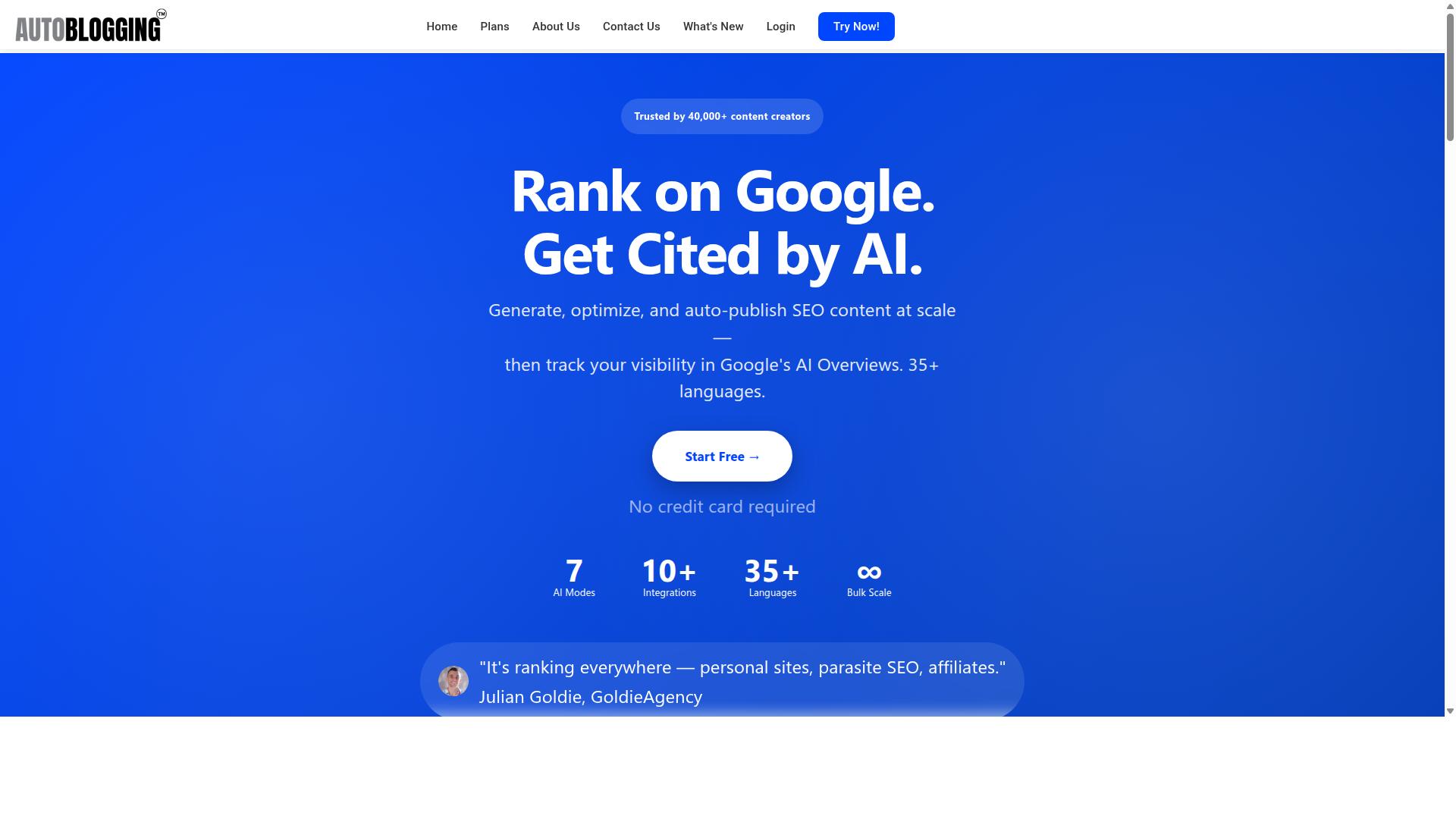
Autoblogging.ai is a SaaS platform developed by Digimetriq.com that uses AI to generate articles automatically, helping bloggers, agencies, and marketers save time and improve their online presence. It was founded in 2022 by Vaibhav Sharda and has been built specifically for people who publish content at scale rather than for occasional one-off writing tasks.
The platform is designed for three main audiences: bloggers, website owners, and agencies. Each group shares a common problem, which is the constant demand for fresh content across multiple sites, niches, or client accounts. Autoblogging.ai positions itself as a way to meet that demand without expanding headcount.
Its stated mission is to help these users save time and improve their online presence through cutting-edge technology. That mission shapes how the product approaches automated content generation. The emphasis is not on replacing the writer's craft in every situation, but on removing the slowest part of the process.
Autoblogging.ai is available globally as an online tool, so access does not depend on a specific region or office. Anyone with an internet connection can use it, which matters for agencies serving clients in different markets and for niche bloggers targeting audiences abroad.
A key part of the brand's philosophy is how it treats human involvement. Autoblogging.ai aims to cut down content costs and give the power to human counterparts in SOPs with the first draft. In practice, that means the tool is meant to handle the heavy lifting of producing an initial version, while a person reviews, refines, and applies their own standards before publishing.
The longer-term vision goes further. Digimetriq aims to replace human counterparts entirely, a goal that reflects where automated content generation is heading as AI writing tools and large language models continue to improve. For now, the first-draft role is the practical value most users get from the platform.
Understanding this positioning matters in a comparison with SEOWriting.ai. Both tools sit in the hands-free blog automation space, but Autoblogging.ai frames itself around cost reduction and workflow support for people who publish regularly. That context sets up the feature and pricing comparisons that follow.
What Is SEOWriting.ai?
SEOWriting.ai is an AI-powered writing tool that helps users create SEO-friendly content quickly, though specific details about its features and pricing should be verified on its official site. It belongs to a growing category of AI writing tools that rely on large language models to turn a short prompt or keyword into a draft article.
The general idea behind tools like this is simple. You provide a topic, a keyword, or a brief outline, and the software generates paragraphs, headings, and meta elements that you can edit before publishing. This makes it useful for SEO content creation at a modest scale.
This section offers a general overview only. Product pages change often, so readers should confirm current capabilities, limits, and terms directly with the vendor.
Typical use cases for an AI article writer in this class include:
- Drafting blog posts from a target keyword or title
- Producing outlines and section headings
- Generating meta titles and descriptions
- Rewriting or expanding existing copy
- Creating short-form content such as product descriptions
Most tools of this type lean on natural language processing and GPT-style models. The output is a starting point rather than a finished asset, so human editing usually remains part of the process.
One important distinction is scope. A writing assistant tends to focus on generating text you then place, format, and publish yourself. Hands-free blog automation is a broader promise, covering the steps that come after drafting, such as publishing and scheduling. That difference in scope is worth keeping in mind as you read the rest of this comparison.
For now, treat SEOWriting.ai as one option among many AI writing tools. Check its official documentation for the latest information before making a decision.
What Is Autoblogging.ai for Hands Free Blog Automation?

For hands-free blog automation, Autoblogging.ai provides a suite of AI modes that can generate articles from keywords, analyze SERP competitors, and even publish directly to your site, minimizing manual effort. It is built as an AI article generation platform, so the entire workflow from keyword to published post can run with very little input from you.
Where many AI writing tools stop at producing a draft, Autoblogging.ai carries the process further. It pairs automated content generation with publishing options, which is what separates a true blog automation software setup from a plain AI copywriting assistant.
The platform organizes its automation around several distinct modes, each suited to a different level of control and output volume.
- Quick Mode (free, single & wizard) for fast, straightforward article creation from a keyword
- Godlike Mode for deeper articles that draw on SERP competitor analysis, LSI keywords, and knowledge graph extraction
- Bulk Generation for producing up to 500 articles at once via CSV
- News Mode with Google News integration for timely content
- Amazon Reviews Mode for product-focused posts
The Godlike Mode is the standout for SEO content creation. By analyzing what already ranks and pulling in LSI keywords and knowledge graph data, it aims to match search intent rather than just string together sentences. That makes it more useful for competitive niches where thin content rarely gains traction.
Bulk Generation changes the scale of the operation. Instead of writing one post at a time, you can submit a CSV and generate up to 500 articles, which suits programmatic SEO, niche blogging, and affiliate marketing sites that need volume.
Autoblogging.ai also supports 35+ integrations and 35+ languages. That combination lets you build automated publishing workflows that push content to your sites without touching each post by hand, and it opens the door to multilingual niche blogging without a separate toolset.
Publishing is where the hands-free promise is delivered. WordPress integration covers unlimited sites with one-click posting, a plugin, and scheduled auto-posting. Content can also go to Web 2.0 platforms such as Medium, Dev.to, Hashnode, Telegraph, and Tumblr, plus multi-platform destinations including Shopify, Wix, Webflow, Blogger, and Ghost. API access, Zapier, and n8n connections let you wire the output into broader content marketing automation.
Beyond generation and publishing, the platform bundles optimization and repurposing tools. These include the Site Optimizer, Semantic SEO Analysis (a 21-point audit), Snippet Optimizer, Topical Maps, Intense Optimizer, Fan Out Queries, AI Infographics, Outreach Prospects, an AI Proofreader, a Human Proofreader, and a Content Repurposer.
For a reader weighing autoblogging platforms, the practical takeaway is simple. Autoblogging.ai is designed for high-volume content creation with minimal intervention, from keyword to live post, which is exactly the use case behind hands-free blog automation and passive income blogs.
Features Compared
When comparing features, Autoblogging.ai offers a broader set of AI-driven automation modes and optimization tools, while SEOWriting.ai focuses on core AI writing capabilities. That single distinction shapes nearly every practical decision a blogger makes, from how fast content gets produced to how well it ranks.
Autoblogging.ai is built as blog automation software first. It pairs multiple generation modes with optimization tools, publishing options, and integrations, so an entire workflow can run with minimal manual input. SEOWriting.ai, by contrast, is generally positioned as an AI article writer for straightforward content creation.
The sections below break this down into three practical categories: how each platform generates articles and handles scale, how each approaches search optimization, and how content actually gets published. Readers weighing hands-free blog automation against a standard AI copywriting tool will find the biggest gaps in the first and third categories.
Article Generation Modes and Bulk Automation
Autoblogging.ai provides multiple article generation modes, including a free Quick Mode, an advanced Godlike Mode with SERP analysis, and Bulk Generation that can produce up to 500 articles via CSV upload. This range lets users match the tool to the task instead of forcing one workflow onto every project.
Quick Mode is free and available as both a single and wizard option, which suits simple articles or a fast first draft. It is a practical entry point for testing output quality before committing to a larger content plan.
Godlike Mode sits at the other end of the spectrum. It draws on SERP competitor analysis, LSI keywords, and knowledge graph extraction to produce more thoroughly researched, higher-quality content. For niche blogging or affiliate marketing sites where topical depth matters, this mode targets the standard serious publishers expect.
Bulk Generation is where scale becomes real. With CSV upload, users can queue up to 500 articles in a single run, which is difficult to match with a tool built around one-off article creation. Additional modes extend the platform further:
- News Mode, which integrates with Google News
- Amazon Reviews Mode, aimed at product-focused content
SEOWriting.ai is generally known for AI article generation, and most users describe it as a dependable single-article workflow. Whether it can match this level of mode flexibility and bulk throughput is worth verifying directly, but on paper the difference in bulk content generation is substantial.
SERP Analysis, Semantic SEO, and Optimization Tools
Autoblogging.ai's Godlike Mode includes SERP competitor analysis, LSI keyword extraction, and knowledge graph integration to help optimize articles for search intent and semantic relevance. These are not add-on features bolted onto a text generator. They are embedded in the generation process itself.
The practical benefit is keyword optimization that reflects what already ranks, rather than what a language model guesses might work. LSI keywords and knowledge graph data widen topical coverage, which supports stronger on-page SEO without manual research for every post.
Beyond generation, Autoblogging.ai ships a wider optimization toolkit:
- Site Optimizer
- Semantic SEO Analysis (a 21-point audit)
- Snippet Optimizer
- Topical Maps and Intense Optimizer
- Fan Out Queries
- AI Proofreader and Human Proofreader
- AI Infographics
- Outreach Prospects
- Content Repurposer
This is a meaningful contrast with SEOWriting.ai, which generally offers SEO-oriented writing features but is not typically described as a full optimization suite. Tools like Topical Maps and Fan Out Queries point toward programmatic SEO and topic cluster planning, not just article drafting.
For readers building authority sites, the combination of SERP analysis at generation time and a 21-point semantic audit afterward covers both search intent and on-page refinement. That two-layer approach is closer to a complete SEO content creation system than a standalone AI writer.
Integrations, Languages, and Publishing Workflow
Autoblogging.ai supports over 35 integrations, including WordPress, and offers publishing in 35+ languages, streamlining the workflow from content creation to publication. For anyone pursuing hands-free blog automation, this category often matters more than raw writing quality.
The WordPress integration covers unlimited sites with one-click publishing, a plugin option, and scheduled auto-posting. That means content scheduling can run without manual uploads, which is the core promise of autoblogging platforms.
Publishing reaches well beyond WordPress:
- Web 2.0 platforms including Medium, Dev.to, Hashnode, Telegraph, and Tumblr
- Site builders and stores such as Shopify, Wix, Webflow, Blogger, and Ghost
- API access, plus Zapier and n8n for connecting other tools
API access and workflow connectors matter for content marketing automation, because they let publishing slot into existing systems rather than replacing them. The 35+ language count also opens international niches that a single-language writer cannot serve.
SEOWriting.ai does offer integrations, though the specific platforms and language coverage are best confirmed on its own documentation. On breadth of publishing destinations and automated content generation at scale, Autoblogging.ai's verified integration list gives it a clear edge for hands-off workflows.
| Feature Area | Autoblogging.ai | SEOWriting.ai |
|---|---|---|
| Generation modes | Quick, Godlike, Bulk, News, Amazon Reviews | General AI article generation |
| Bulk output | Up to 500 articles via CSV | Not specified |
| SERP and semantic tools | SERP analysis, LSI keywords, knowledge graph, 21-point audit | SEO-oriented writing features |
| Integrations | 35+, including WordPress, API, Zapier, n8n | Integrations available |
| Languages | 35+ | Not specified |
The takeaway is straightforward. SEOWriting.ai handles the writing task, while Autoblogging.ai covers writing, optimization, and publishing as one connected pipeline, which is what hands-free blog automation ultimately requires.
Pricing Compared
Autoblogging.ai offers tiered monthly plans ranging from $19 for 40 credits to $999 for 5,000 credits, with annual options and credit rollover, while SEOWriting.ai's pricing should be checked on its official site. That difference in transparency matters when you are comparing AI writing tools for long-term blog automation.
Autoblogging.ai publishes every tier openly, so you can map cost to output before committing. SEOWriting.ai presents its plans on its own website, and readers should verify current rates and credit rules there directly.
| Plan | Monthly Price | Credits | Annual Price |
|---|---|---|---|
| Starter | $19 | 40 | $12/mo ($148/year) |
| Regular | $49 | 120 | $32/mo ($382/year) |
| Standard | $99 | 300 | $64/mo ($772/year) |
| Gold | $179 | 600 | $116/mo ($1,396/year) |
| Premium | $249 | 1,000 | $162/mo ($1,942/year) |
| Enterprise | $999 | 5,000 | $649/mo ($7,792/year) |
The annual billing option cuts costs meaningfully. A Starter plan drops from $19 to $12 per month, and Enterprise falls from $999 to $649 per month. For anyone running hands-free blog automation across multiple sites, that gap compounds quickly.
Credit rollover is included on every plan, so unused credits carry forward instead of expiring at the end of a billing cycle. That is a real advantage for niche blogging and affiliate marketing projects where publishing volume fluctuates month to month.
New accounts receive 10 free credits per month with no credit card required, which lets you evaluate the platform before paying. Additional credits can also be purchased separately if you outgrow your tier without wanting to jump to the next plan.
For readers who prefer a fully managed route, Done For You packages are available: Starter at $1,200 for 1,000 articles, Pro at $1,600, Corp at $4,000, and Senpai at $10,000, each covering 1,000 articles. Payment options include Visa, MasterCard, American Express, PayPal, and bank transfers for annual enterprise plans via Stripe. You can cancel anytime.
When weighing overall value in this comparison, the deciding factor is usually cost per article against the credits included. Autoblogging.ai's published tiers make that math straightforward, while SEOWriting.ai's pricing requires a direct check on its site before any like-for-like comparison is possible.
Who Should Choose Autoblogging.ai
Autoblogging.ai is ideal for bloggers, SEO professionals, marketing agencies, and affiliate marketers who need to produce large volumes of optimized content efficiently. Its design centers on hands-free blog automation, which means users spend less time managing the writing process and more time on strategy, promotion, and growth.
The platform serves a wide range of site types, including personal sites, parasite SEO, affiliate sites, client websites, portfolio sites, and local sites. That flexibility makes it a strong fit for bulk content generation across multiple projects rather than a single blog.
Choosing between SEOWriting.ai and Autoblogging.ai often comes down to how much manual oversight you want. Autoblogging.ai leans toward automation at scale, while general AI writing tools tend to require more hands-on direction per article.
Below are the audiences and use cases where Autoblogging.ai tends to be the stronger match.
- Bloggers and niche blogging: Writers running one or several niche sites benefit from producing content consistently without writing every post by hand.
- SEO professionals: Those handling keyword optimization, search intent, and on-page SEO across many pages need volume without sacrificing structure.
- Marketing agencies: Agencies managing client websites value the ability to serve multiple accounts and deliver content on a repeatable basis.
- Affiliate marketers: Affiliate sites and passive income blogs depend on steady publishing to build topical coverage and capture long-tail queries.
- Content creators: Creators who want to scale output while keeping a consistent voice can lean on automation for the heavy lifting.
For programmatic SEO and large site builds, the appeal is straightforward. When you need dozens or hundreds of pages rather than a handful, a tool built for automated content generation saves considerable time compared with drafting each piece individually.
Affiliate marketing and portfolio sites also fit well. These projects often span multiple topics and require regular updates, so a system that supports content scheduling and repeatable workflows keeps publishing on track.
Local sites represent another practical use case. A business covering several service areas can maintain separate pages for each location without treating every page as a fresh writing project.
| User Type | Primary Need | Why Autoblogging.ai Fits |
|---|---|---|
| Bloggers | Consistent publishing | Hands-free automation for regular output |
| SEO professionals | Optimized content at scale | Supports keyword optimization and bulk generation |
| Marketing agencies | Multiple client sites | Serves client websites across accounts |
| Affiliate marketers | Topical coverage | Built for affiliate sites and passive income blogs |
| Content creators | Higher output | Reduces manual drafting effort |
In short, if your priority is high-volume, hands-free automation across many pages and projects, Autoblogging.ai aligns well with that goal. Readers who prefer to guide every sentence themselves may find a more manual tool like SEOWriting.ai a closer fit, but for scale and consistency, Autoblogging.ai is the stronger choice.
Who Should Choose SEOWriting.ai
SEOWriting.ai may be a better fit for users who need a straightforward AI writing tool for smaller-scale content creation and prefer a simpler interface. For someone who writes a handful of posts each month and wants help drafting outlines, intros, or product descriptions, that lighter approach can feel less overwhelming than a full blog automation platform.
The tool tends to appeal to solo bloggers and freelancers who treat AI as an assistant rather than a replacement for their own workflow. They may enjoy reviewing each draft, adjusting tone, and publishing manually. In that setup, the value comes from faster first drafts, not from removing the human from the loop entirely.
Small marketing teams with limited content needs may also find it useful. If your calendar only calls for a few articles per quarter, a simpler AI article writer can cover the basics without the learning curve of a more involved system. The trade-off is that scaling up later often means rethinking your tooling.
Consider SEOWriting.ai if any of the following describe you:
- You publish occasionally and are comfortable handling scheduling, publishing, and internal linking yourself.
- You want a lower-commitment entry point into AI copywriting before investing in dedicated blog automation software.
- You prefer to stay hands-on with every piece rather than rely on automated content generation.
- Your focus is general writing help, not programmatic SEO or bulk content generation at scale.
On the other hand, anyone chasing hands-free blog automation for a growing niche site or affiliate marketing project will likely outgrow a basic writing assistant. Tasks like keyword optimization, content scheduling, and WordPress integration usually need a platform built for end-to-end publishing, which is where a dedicated autoblogging tool tends to make more sense.
Since features and pricing change often, it is worth checking the official SEOWriting.ai site for the latest details before committing. Match the tool to your actual publishing volume, and be honest about how much manual work you are willing to keep doing each week.
Who Should Choose Autoblogging.ai for Hands Free Blog Automation
For hands-free blog automation, Autoblogging.ai is suited for agencies, affiliate marketers, and niche bloggers who want to scale content production with minimal manual input. The platform is built around output volume rather than one-off drafting, which changes who gets the most value from it.
If your workflow depends on publishing hundreds of posts across several sites, manual drafting stops being realistic. Autoblogging.ai supports bulk content generation of up to 500 articles, which fits teams managing multiple properties at once.
Affiliate marketers running passive income blogs often need steady publishing across many topics and keywords. Bulk generation keeps those sites fed without a writer assigned to each one.
Agencies face a similar math problem. Client content calendars rarely pause, and content marketing automation lets a small team cover more accounts than a manual process would allow.
Niche bloggers sit at the other end of the scale, but the logic holds. One person covering a narrow topic still needs consistent output to build topical depth over time.
Autoblogging.ai is trusted by 40,000+ content creators, a signal that the bulk approach resonates with people who publish at volume rather than occasionally.
The platform offers 10+ AI modes, which matters when a single site needs different article types rather than one repeated format. Output also spans 35+ languages, useful for anyone running regional or multilingual properties.
Publishing is where hands-free automation either works or breaks down. With 35+ integrations and one-click WordPress publish, generated drafts can move toward a live site without a manual copy-and-paste step for every post.
SEO content creation at this scale also needs supporting tools, not just text. Autoblogging.ai includes SERP competitor analysis, semantic SEO tools, a 21-point SEO audit, and featured snippet optimization.
A human proofreader is included in all plans, which addresses the quality concern that comes with any high-volume workflow. Credits roll over, so unused capacity is not lost between cycles.
Support runs 24/7, and new features ship weekly, both relevant when automation is a core part of your publishing stack rather than a side experiment.
This profile points to a specific reader: someone who values throughput, multi-site management, and reduced manual steps over drafting every post by hand. If your bottleneck is volume and consistency, Autoblogging.ai is the stronger fit.
Final Verdict
After comparing features and pricing, Autoblogging.ai emerges as the stronger choice for hands-free blog automation, thanks to its advanced AI modes, bulk generation, and extensive integrations.
Both tools belong to the same category of AI writing tools, but they target different levels of ambition. SEOWriting.ai remains a viable option for bloggers who need occasional help drafting articles. Autoblogging.ai, by contrast, is built for people who want an entire publishing operation running with minimal manual input.
The clearest differences sit in scale and reliability. Autoblogging.ai is trusted by 40,000+ creators, holds a 4.9 rating, and has produced over 1M+ articles. Those numbers reflect a platform tested across many niche blogging and affiliate marketing setups rather than a single-use drafting tool.
| Factor | Autoblogging.ai | SEOWriting.ai |
|---|---|---|
| AI modes | 10+ AI modes | General drafting modes |
| Languages | 35+ languages | Multiple languages supported |
| Integrations | 35+ integrations | Limited integration options |
| Credit handling | Credit rollover | Credits tied to billing cycle |
| Support | 24/7 support, weekly updates, human proofreading | Standard support |
For automation-focused users, several details matter more than raw feature counts. Credit rollover means unused capacity is not wasted, which suits irregular publishing schedules. Weekly updates keep the underlying models current, and human proofreading adds a quality layer that pure automated content generation often lacks.
SEOWriting.ai can still serve simpler needs well. A solo blogger publishing a few posts a month may find its lighter approach sufficient. The trade-off is depth: fewer modes, fewer integrations, and less emphasis on end-to-end content marketing automation.
If your goal is genuine hands-free blog automation, from bulk content generation through WordPress integration, Autoblogging.ai is the recommendation. It covers more of the workflow in one place and supports it with round-the-clock assistance.
For more details, reach out to the team directly. Email [email protected] or call +91 84605-06553. You can also visit the official website to explore the platform further.
Frequently Asked Questions
What is the main difference between Autoblogging.ai and SEOWriting.ai?
Both tools generate articles with AI, but Autoblogging.ai is built specifically for hands-free blog automation and high-volume publishing, while SEOWriting.ai is a broader AI writing assistant. Autoblogging.ai offers 10+ AI modes including Quick Mode, Godlike Mode, Bulk Generation (up to 500 articles via CSV) and News Mode, plus 35+ integrations and 35+ languages. If your priority is publishing at scale with minimal manual work, Autoblogging.ai is designed for exactly that.
How does pricing compare between the two platforms?
Autoblogging.ai monthly plans start at $19 for 40 credits and scale up to $999 for 5,000 credits, with annual plans also available and credits that roll over. SEOWriting.ai's publicly listed pricing starts around $19 per month, with a free tier and annual discounts noted by third-party sources. Exact plan details and limits change over time, so it's worth checking each provider's current pricing page before deciding.
Which tool is better for bulk, hands-free blog automation?
Autoblogging.ai is positioned as best for bulk article generation and high-volume publishing, with a Bulk Mode that handles hundreds of articles from a CSV upload. Combined with credits rollover, 35+ integrations and new features shipped weekly, it's built to keep a content pipeline running with minimal intervention. SEOWriting.ai is a capable AI writing tool, but bulk automation at this scale is where Autoblogging.ai focuses its feature set.
Does Autoblogging.ai offer a free mode or trial?
Yes - Autoblogging.ai's Quick Mode is free and available in both single and wizard formats, so you can generate content and test the platform before committing to a paid plan. Paid monthly plans then start at $19 for 40 credits. This lets you evaluate output quality firsthand rather than relying on marketing claims alone.
Can I use Autoblogging.ai for client websites and agencies?
Absolutely. Autoblogging.ai is used by bloggers, website owners, SEO professionals, marketing agencies, affiliate marketers and content creators, covering personal sites, client websites, affiliate sites, parasite SEO, portfolio sites and local sites. It's trusted by 40,000+ content creators with a 4.9 average rating and 1M+ articles generated, and 24/7 support is included. Agencies managing multiple client properties can use bulk generation and integrations to scale output efficiently.
How do the two tools handle SEO optimization and languages?
Autoblogging.ai's Godlike Mode performs SERP competitor analysis, LSI keyword research and knowledge graph extraction to build SEO-focused articles, and the platform supports 35+ languages. SEOWriting.ai also markets SEO-oriented article creation, so both take search optimization seriously. The practical difference is that Autoblogging.ai pairs these SEO features with bulk automation, rollover credits and a human proofreader included in eligible plans, making it well suited to sustained publishing workflows.
Recommended Resources: